A broken garage door spring announces itself: a bang like a gunshot from the garage, and a door that will not lift or that slams down when you try. Because the door is unusable and the repair is genuinely dangerous to attempt, it is also a repair people tend to buy in a hurry – which is exactly when overpaying happens.
Here is what garage door spring replacement actually costs in 2026, which parts of a quote are legitimate and which are padding, and how to tell in about thirty seconds whether your door has torsion or extension springs before you even pick up the phone.
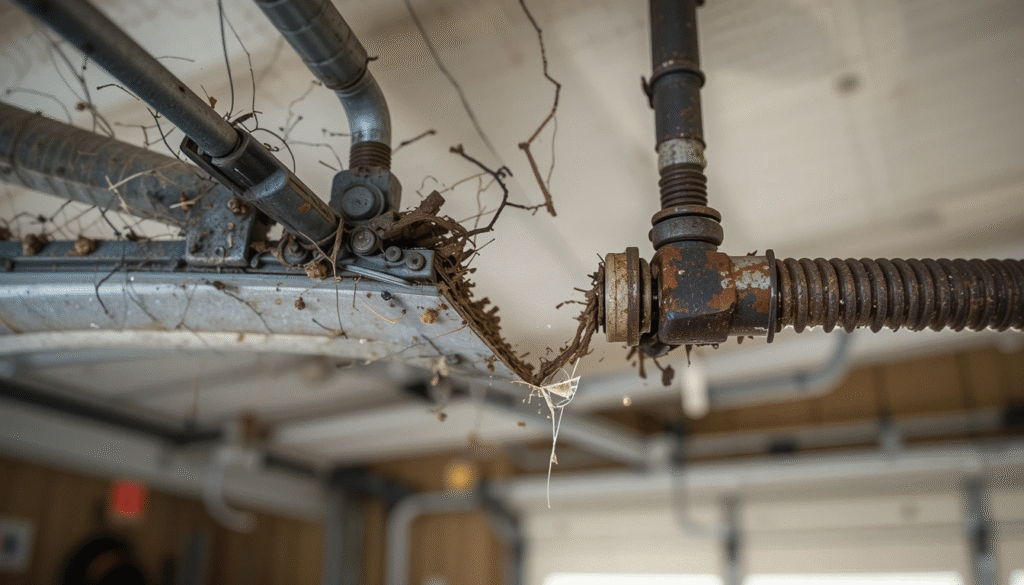
Garage Door Spring Replacement Cost at a Glance
| Scenario | 2026 cost range |
|---|---|
| National average, one door | About $250 |
| Single spring replaced, parts and labour | $150 – $350 |
| Extension spring system, complete | $120 – $200 |
| Torsion spring system, complete | $150 – $350 |
| Double-car door, two springs | $300 – $600 |
| Insulated or heavy door | $250 – $400 |
| Two doors done in one visit | $275 – $425 |
| Springs plus cables | $200 – $500 |
| Converting extension to torsion | $400 – $800 |
| DIY parts only | $50 – $150 per spring |
Figures reflect 2026 national pricing compiled by HomeGuide and Angi. Your local quote will land inside these bands unless something unusual is going on.
Which Spring Do You Have?
Stand inside the garage with the door closed and look up.
- Torsion springs sit horizontally on a metal shaft directly above the door opening, usually one long spring on a single door or two on a double. They wind and unwind as the door moves.
- Extension springs run horizontally along the upper tracks on each side of the door, stretching as the door closes. They almost always come in pairs and usually have a safety cable running through the middle.
This matters because it sets your price band and, more importantly, your risk profile. Torsion springs store enormous rotational energy and require winding bars to service safely. Extension springs whip when they fail, which is what the safety cable is there to contain.
What Drives the Price
Spring type and quality
The spring itself is a surprisingly small share of the bill. Extension springs run roughly $50 to $100 each as a part, torsion springs $75 to $150. Where the money goes is the cycle rating. A standard spring is rated for around 10,000 cycles – one open and one close is a cycle – which for a typical household is about 7 to 10 years. High-cycle springs rated 20,000 to 50,000 cycles cost 30 to 60 percent more and are worth it if your garage is the main entrance to the house.
Labour
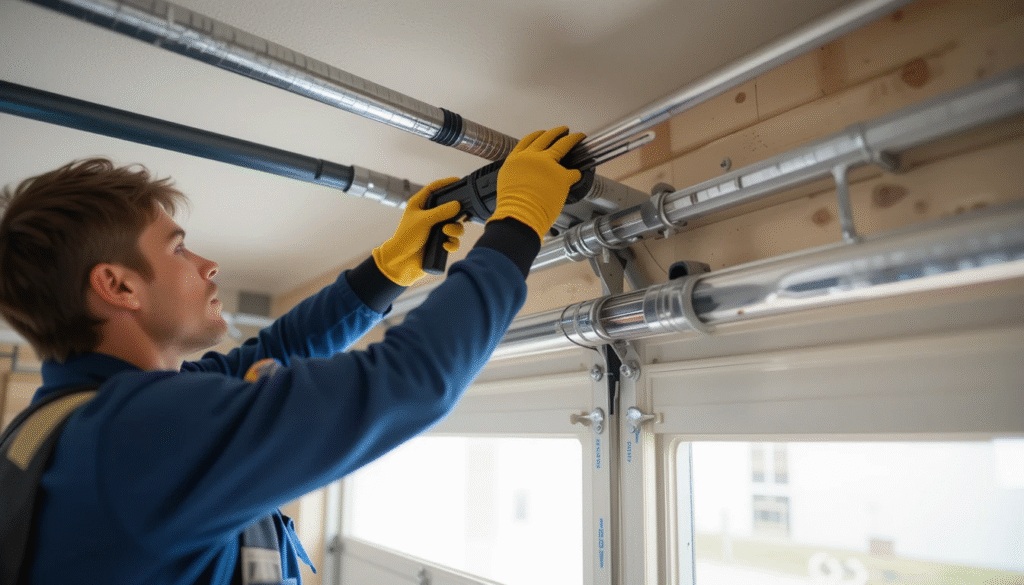
Residential labour runs $75 to $150 for a straightforward swap, and most technicians complete it in 45 to 90 minutes. Commercial-grade doors run $150 to $300 in labour.
Door size and weight
A double door needs two springs and heavier hardware. Insulated doors weigh substantially more than single-layer steel and need stronger springs, which is why insulated doors land at $250 to $400 rather than the base range. The difference between a 7-foot and 8-foot door is minimal, often only $5 to $10 per spring.
Location
Urban and high-cost-of-living areas typically run 15 to 25 percent above rural pricing, driven by labour rates and overhead rather than parts.
Timing
This is the single biggest lever you control. Emergency, evening and weekend calls carry premiums that can add $50 to $150 to the same job. If your car is not trapped inside, waiting until Monday morning is free money.
Line Items to Question on a Quote
Not every add-on is a scam – some are genuinely necessary – but you should understand what you are being charged for.
| Line item | Typical cost | Is it legitimate? |
|---|---|---|
| Service call fee | $50 – $100 | Common and usually fair. Ask whether it is waived if you proceed with the work. |
| Old spring disposal | $20 – $50 | Reasonable, though many companies fold it into labour. Worth asking. |
| Cables and drums | $30 – $100 | Legitimate if worn. Cables fray over time and often are due when springs are. Ask to see them. |
| Opener rebalancing | $50 – $75 | Legitimate. The door must be rebalanced after a spring change or the opener wears prematurely. |
| Rollers | $50 – $150 | Optional. Worth doing if they are nylon-worn or noisy, easy to decline if not. |
| Travel or mileage charge | $25 – $75 | Fair if you are outside their normal service area, questionable if you are not. |
| Full door replacement pitch | $1,000+ | Be sceptical. A broken spring on an otherwise sound door is not a reason to replace the door. |
If a technician recommends a new door, get a second opinion before committing. Our guide to garage door replacement costs covers what that job should actually run if it does turn out to be justified.
Should You Replace Both Springs?
On a two-spring system, yes – almost always. The springs were installed at the same time and have gone through identical cycle counts, so when one fails the other is typically weeks or months behind it. Replacing both together costs perhaps 30 to 40 percent more than one, versus paying a second full service call and labour charge shortly afterwards.
The exception is a genuinely young system where one spring failed from a defect rather than fatigue. If the springs are under two years old, replacing the failed one is defensible.
DIY: The Honest Assessment
Parts alone cost $50 to $150 per spring, so the theoretical saving is $100 to $250. That is a real number, and so is the risk.
Why torsion springs are different
A wound torsion spring stores enough energy to break bones. Servicing it requires two properly sized steel winding bars – not screwdrivers, not rebar – and a methodical unwinding procedure. Improvised tools slipping under load is the mechanism behind most serious injuries in this repair. The U.S. Consumer Product Safety Commission tracks thousands of garage door related injuries annually, and spring work is disproportionately represented.
What else goes wrong
- Wrong spring specification. Springs are sized by wire diameter, inside diameter, length and wind direction. Guessing gives you a door that is unbalanced from day one.
- Voided warranties. Most spring warranties, and many opener warranties, require professional installation.
- Opener damage. An improperly balanced door forces the opener to carry weight it was never designed to lift, and openers cost far more than the labour you saved.
- Cost of correction. Calling a professional to fix a botched DIY attempt costs more than hiring one at the start.
When DIY is reasonable
- Extension springs on a light single-car door, with the safety cables intact
- You already own winding bars sized for your spring and have done the job before
- You have the exact manufacturer specification for the replacement spring
- You have a second person present
For most homeowners, this is the repair to hire out. If the door itself is misbehaving rather than the springs, our guide on what to do when a garage door will not close covers the cheaper causes worth ruling out first.

DIY vs Professional
| Factor | DIY | Professional |
|---|---|---|
| Cost | $50 – $150 per spring | $150 – $600 total |
| Time | 2 – 4 hours if experienced | 45 – 90 minutes |
| Tools needed | Winding bars, vice grips, ladder, sockets | Supplied |
| Injury risk | Significant | Minimal |
| Warranty | Usually void | Parts and labour, typically 1 – 5 years |
| Balance and calibration | Down to you | Included and tested |
| Related checks | None | Cables, rollers, tracks, opener force settings |
How Long Springs Last, and Warning Signs
| Spring type | Typical lifespan | Cycle rating |
|---|---|---|
| Torsion | 7 – 14 years | 10,000 – 20,000 cycles |
| Extension | 4 – 10 years | 5,000 – 15,000 cycles |
| High-cycle torsion | 15 – 20 years | 20,000 – 50,000 cycles |
Signs that a spring is near the end:
- The door opens jerkily, or feels much heavier than it used to when lifted manually
- A visible gap in the coil of a torsion spring – this means it has already snapped
- The door drops fast or slams the last foot
- Loud bangs, grinding or squealing during operation
- The door will not stay put halfway when disengaged from the opener
- Cables hanging loose or wrapped unevenly on the drums
The halfway test is the most useful single check. With the opener disengaged, lift the door to waist height and let go. A properly balanced door stays roughly where you left it. If it drops or shoots up, the springs are out of balance and due for attention.
How to Keep the Bill Down
- Get three quotes. Prices for the identical job vary widely within a single metro area.
- Avoid emergency scheduling. Waiting until normal business hours saves $50 to $150.
- Ask for the cycle rating. High-cycle springs cost more upfront and typically outlast two standard sets.
- Replace both at once. Avoids a second service call within the year.
- Ask whether the service call fee is credited against the work if you proceed.
- Book an annual tune-up. At $40 to $80 it catches fraying cables and worn rollers before they take a spring with them.
- Lubricate twice a year. A garage-door-specific lubricant on springs, hinges and rollers – never on the tracks themselves – measurably extends spring life.

Choosing a Company
- Confirm licensing and insurance before they arrive, not after
- Ask for the total, itemised, before work begins – parts, labour, service call and disposal
- Get the warranty in writing, covering both parts and labour, with the duration of each
- Be wary of unusually low advertised prices, which are frequently a service call fee in disguise
- Check recent reviews specifically mentioning spring work rather than general ratings
- Avoid anyone who will not quote a range over the phone once you have described the door
Conclusion
For most homeowners in 2026, garage door spring replacement lands between $150 and $350 for a single door and $300 to $600 for a double, with a national average around $250. The spring is cheap; the labour, the timing and the add-ons are where the number moves.
The two decisions that save the most money are simple: do not book it as an emergency if the car is not trapped, and replace both springs while the technician is already there. Attempting the repair yourself to save a hundred dollars is the one place in this project where the maths does not hold up. For more garage projects, see our Crafts & Tools category.
Frequently Asked Questions
How much does it cost to replace a garage door spring in 2026?
Expect $150 to $350 for a single door including parts and labour, with a national average of about $250. Double-car doors with two springs run $300 to $600, and insulated or heavy doors $250 to $400.
What is the difference in cost between torsion and extension springs?
As parts, extension springs cost about $50 to $100 each and torsion springs $75 to $150. Installed, a complete extension system runs $120 to $200 and a torsion system $150 to $350. Torsion costs more but lasts longer and operates more smoothly.
Can I replace a garage door spring myself?
Technically yes, but torsion springs store enough energy to cause serious injury and require proper winding bars and the exact replacement specification. For most homeowners the $100 to $250 saving does not justify the risk, and DIY installation voids most warranties.
Should I replace one spring or both?
Replace both. Paired springs accumulate identical cycle counts, so the second usually fails soon after the first. Doing both together costs 30 to 40 percent more than one, versus paying a second full service call within months.
How long do garage door springs last?
Torsion springs typically last 7 to 14 years or 10,000 to 20,000 cycles. Extension springs last 4 to 10 years or 5,000 to 15,000 cycles. High-cycle torsion springs rated 20,000 to 50,000 cycles can last 15 to 20 years.
Why do garage door spring prices vary so much by location?
Labour rates, business overhead and demand differ by market. Urban homeowners typically pay 15 to 25 percent more than rural ones, though rural customers may face travel charges of $25 to $75.
Is a service call fee normal?
Yes. Most companies charge $50 to $100 to dispatch a technician. Many credit it against the repair if you proceed, so it is always worth asking before booking.
How do I know if my spring is broken or something else is wrong?
Look for a visible gap in a torsion spring coil, which is definitive. Otherwise, disengage the opener and lift the door to waist height. A balanced door stays put; one that drops or rises has a spring problem. If the door lifts normally but the opener will not move it, the fault is more likely the opener or its settings.