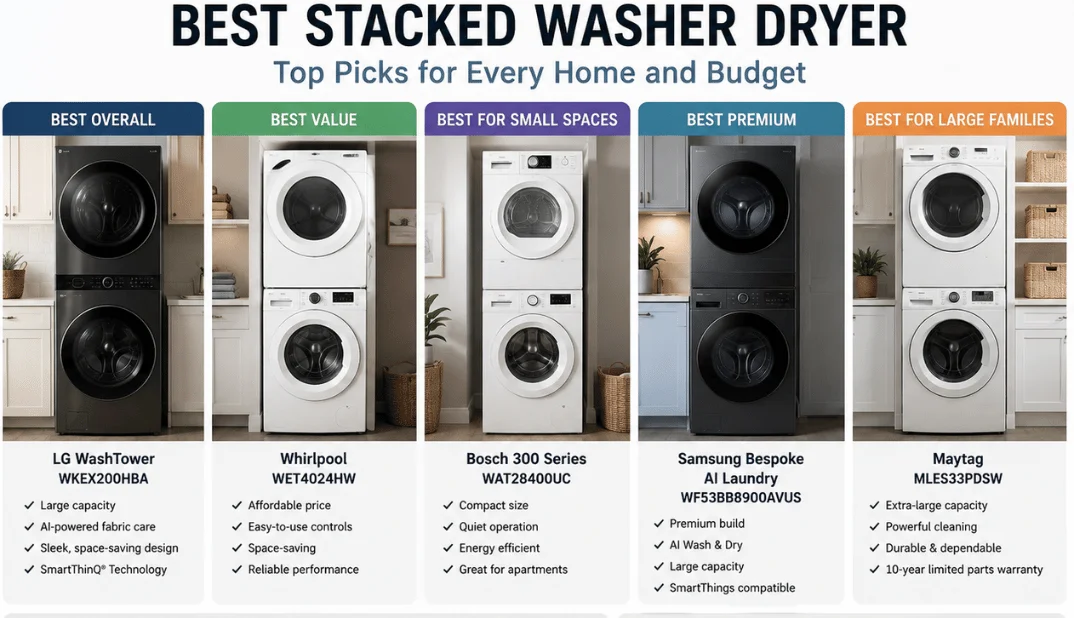
The best stacked washer dryer for most homes is the LG WashTower WKEX200HWA. It offers full-size capacity, easy-to-reach center controls, and a compact vertical layout without making your laundry area feel cramped.
Quick answer: For most households, the LG WashTower offers the strongest mix of capacity, convenient controls, and space efficiency. Its washer holds 4.5 cubic feet, while the dryer holds 7.4 cubic feet. Choose a Miele W1/T1 stack instead if you need a compact, ventless setup for a closet, apartment, or older home.
| Pick | Best For | Washer Capacity | Dryer Capacity | Configuration |
|---|---|---|---|---|
| LG WashTower WKEX200HWA | Best overall | 4.5 cu. ft. | 7.4 cu. ft. | One-piece tower |
| Electrolux 600 Series ELTE7600 | Fabric care and large dryer | 4.5 cu. ft. | 8.0 cu. ft. | Laundry tower |
| Samsung Bespoke AI Laundry Hub | Smart features | 4.6 cu. ft. | 7.6 cu. ft. | Laundry tower |
| Miele W1 + T1 | Compact, ventless spaces | Compact | Compact | Separate stack |
| Whirlpool WET4027HW | Simple value | 3.5 cu. ft. | Full-size dryer | Laundry center |
The product capacities and configurations above are based on current manufacturer listings as of August 2026.
How We Chose the Best Stacked Washer Dryer Picks
Current buying guides from Good Housekeeping, The Spruce, Forbes, and other appliance specialists favor a mix of LG, Electrolux, Miele, Samsung, and Whirlpool models. LG appears especially often among current full-size recommendations.
We narrowed the field using factors that affect ownership after installation:
- Washer and dryer capacity.
- Floor-space requirements.
- Control accessibility.
- Vented versus ventless drying.
- Smart features that offer practical value.
- Flexibility if one appliance needs replacement.
- Current manufacturer support and model availability.
That last point matters. A discontinued machine can look attractive on clearance, but replacement parts and matching units may become harder to find.
1. LG WashTower WKEX200HWA: Best Overall
The LG WashTower is our top pick for a typical household. It combines a 4.5-cubic-foot front-loading washer with a 7.4-cubic-foot electric dryer in a single vertical cabinet. The center control panel keeps the settings within comfortable reach.
It also receives strong support from current independent roundups. Good Housekeeping names the WashTower its preferred single-unit option, while The Spruce also highlights LG’s tower-style laundry setup.
Pros
- Full-size washer and dryer capacity.
- Center-mounted controls.
- Space-saving design.
- Clean, integrated appearance.
- Good choice for laundry closets.
Cons
- Less replacement flexibility than two independent machines.
- Requires careful measurements of height, depth, and hookup.
- One-piece design may complicate future service decisions.
Verdict: Pick the LG if you want a single unit that handles most family laundry loads well without sacrificing full-size capacity.
2. Electrolux 600 Series Laundry Tower: Best for Fabric Care

The Electrolux ELTE7600 pairs a 4.5-cubic-foot washer with an 8.0-cubic-foot dryer. The cabinet measures about 76.25 inches high, 27 inches wide, and 32 inches deep.
Its main advantage is its generous dryer capacity. That extra room can help when drying bedding, towels, and bulky loads. Electrolux also emphasizes its SmartBoost premixing system in its current product materials.
Pros
- Large 8.0-cubic-foot dryer.
- Full-size washer.
- Energy Star certified.
- Strong option for bedding and family loads.
Cons
- Larger than compact stacks.
- May be excessive for one-person households.
- Requires enough closet depth for installation and connections.
Verdict: This is the better choice when dryer capacity and clothing care matter more than having the smallest possible footprint.
3. Samsung Bespoke AI Laundry Hub: Best Smart Option
Samsung’s Bespoke AI Laundry Hub combines a 4.6-cubic-foot washer with a 7.6-cubic-foot electric dryer. Current versions include features such as Flex Auto Dispense, Smart Dial, OptiWash, and Steam Wash.
Automatic dispensing is more useful than many features of appliance apps. You can load detergent less frequently and let the machine manage appropriate amounts across cycles.
Pros
- Useful automatic detergent dispensing.
- Large dryer.
- Centralized controls.
- Strong smart-home feature set.
- Full-size front-load design.
Cons
- More electronics than a basic laundry center.
- Smart features may not matter to every buyer.
- A larger number of features can mean a steeper learning curve.
Verdict: Choose Samsung if automation and app-connected controls are features you’ll actually use rather than ignore.
4. Miele W1 and T1: Best Compact Ventless Stack
A Miele W1 washer and T1 dryer suit homes where installation limitations matter most. The machines can be stacked, and the T1 uses heat-pump drying without requiring an exterior dryer vent. Miele also uses a 120-volt electrical design on its T1 heat-pump models.
That combination makes the pair especially useful in apartments, closets, condos, and older homes where adding a conventional dryer exhaust would be difficult.
Pros
- Compact footprint.
- Ventless heat-pump drying.
- Stackable as separate appliances.
- Lower drying temperatures.
- More installation flexibility than a vented dryer.
Cons
- Smaller load capacity than full-size towers.
- Premium purchase price.
- Drying cycles can differ from those of conventional vented machines.
Verdict: Miele is our preferred compact option when ventless operation and installation flexibility matter more than maximum capacity.
5. Whirlpool WET4027HW: Best Simple Value
The Whirlpool WET4027HW follows the traditional laundry-center format. Its washer has a 3.5-cubic-foot capacity, 9 wash cycles, and an AutoDry system. The cabinet is roughly 75.5 inches high, 27.25 inches wide, and 32.44 inches deep.
It makes sense for buyers who want familiar controls and don’t need a large collection of app-connected features. Forbes also includes a Whirlpool electric stacked laundry center among its current value-oriented recommendations.
Pros
- Straightforward controls.
- Space-saving vertical design.
- Lower-cost alternative to many premium towers.
- Familiar top-load laundry-center layout.
Cons
- Smaller washer than those in premium full-size towers.
- Fewer advanced features.
- Traditional layout may be less convenient than center-mounted controls.
Verdict: Whirlpool is a practical choice for a rental, secondary laundry room, or budget-focused household.
Laundry Tower vs. Separate Stackable Machines
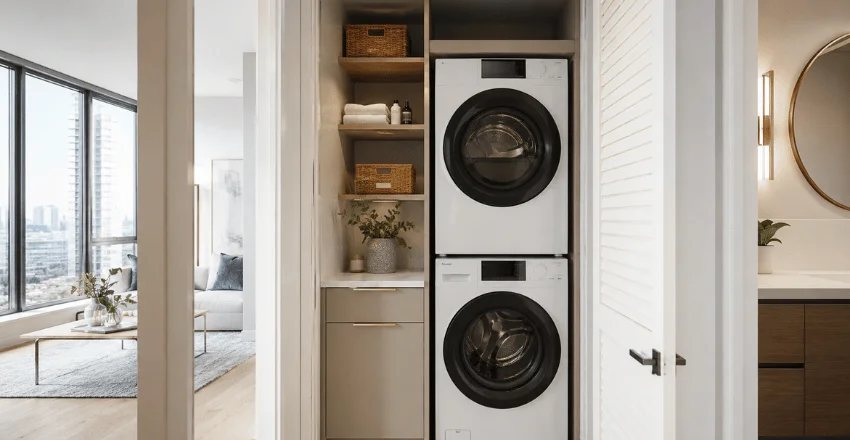
“Stacked” can describe two different setups. A laundry tower or laundry center is designed as one coordinated vertical appliance. A stackable pair consists of two separate machines mounted together with a compatible stacking kit. Whirlpool also distinguishes between these formats in its buying guidance.
| Feature | One-Piece Laundry Tower | Separate Stackable Pair |
| Controls | Often centralized | Dryer controls may sit high |
| Installation | One integrated cabinet | Requires compatible stacking kit |
| Replacement | Usually treated as one system | One appliance can often be replaced |
| Model flexibility | Limited to tower configuration | Broader washer/dryer combinations |
| Best for | Simple, coordinated setup | Long-term flexibility |
If easy-to-reach controls matter, a modern tower has a clear advantage. If repair and replacement flexibility matter more, two separate machines may make more sense.
Measure Your Laundry Space Before Ordering
Full-size stacked appliances are commonly around 27 inches wide and can reach roughly 77 to 80 inches high. Depth often falls between 32 and 34 inches before accounting for hoses, plugs, and venting clearance. Compact models are typically 24 inches wide.
Measure these areas before choosing a model:
- Width: Measure the narrowest point, not just the back wall.
- Height: Include cabinets, shelves, and ceiling obstructions.
- Depth: Leave room for hoses, plugs, and dryer ducting.
- Door swing: Confirm that both appliance doors can open fully.
- Hookups: Check the water, drainage, electrical service, gas, and vent locations.
- Access path: Measure doorways, stairwells, and hallways used for delivery.
If your laundry area is part of a garage remodel, plan the appliance footprint before finishing the walls, flooring, or storage. Homoya’s guide to garage conversion planning provides useful context for organizing utility areas and durable surfaces.
Vented or Ventless: Which Dryer Type Is Better?
A conventional vented dryer pushes warm, damp air outdoors. It remains a practical choice when your laundry room already has a short, properly installed exhaust route.
A heat-pump dryer recirculates air and doesn’t need an exterior dryer vent. That can make it easier to install in interior closets, condos, and apartments. Miele’s current T1 line is one example of this approach.
If you choose a vented model, lint and duct maintenance become part of ownership. Homoya’s dryer vent cleaning guide explains how regular cleaning supports airflow and reduces lint buildup.
What Capacity Do You Need?
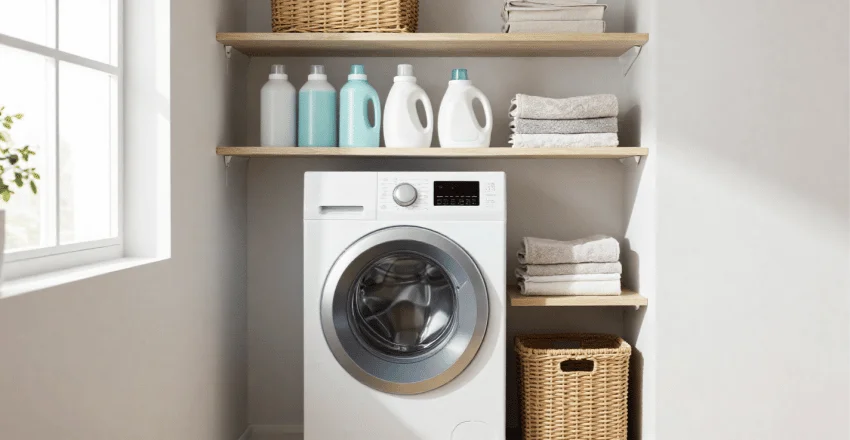
A washer with around 4.5 cubic feet of capacity is a sensible full-size target for many households. Several leading towers in this comparison fall within that capacity range.
Dryer capacity should be larger because wet clothing needs room to tumble. The LG, Samsung, and Electrolux models here range from 7.4 to 8.0 cubic feet on the dryer side.
Small households may prefer a compact stack instead. Large families should prioritize drum capacity before paying extra for Wi-Fi controls or specialty cycles.
The Bottom Line
For most households, LG’s WashTower is our top pick because it balances capacity, convenient controls, and efficient use of floor space. Electrolux gives you more dryer room, while Samsung is stronger for smart features. Miele makes more sense when you need a compact, ventless installation, and Whirlpool covers the simpler, value-focused end of the market.
Start by measuring your available width, height, depth, venting, and hookups. Then compare capacity and controls. Following that order helps prevent an impressive appliance from becoming an expensive fit problem. For more advice on buying and maintaining appliances, browse Homoya’s home appliance guides.
Frequently Asked Questions
The LG WashTower WKEX200HWA is our top all-around choice. Its 4.5-cubic-foot washer, 7.4-cubic-foot dryer, and center-mounted controls combine full-size capacity with a space-saving vertical design.
Neither design is better for every home. A tower gives you coordinated controls and a tidy, single-unit layout. Separate appliances give you more freedom to replace one machine without replacing the other.
No. Standard electric and gas dryers usually need an exhaust vent, but heat-pump dryers do not. Miele’s T1 is a current example of a ventless heat-pump dryer that can be stacked with a matching W1 washer.
Yes, if you choose compact appliances designed for that width. Full-size stacks are typically about 27 inches wide, while compact models are around 24 inches wide. Always check the manufacturer’s installation drawing before ordering.