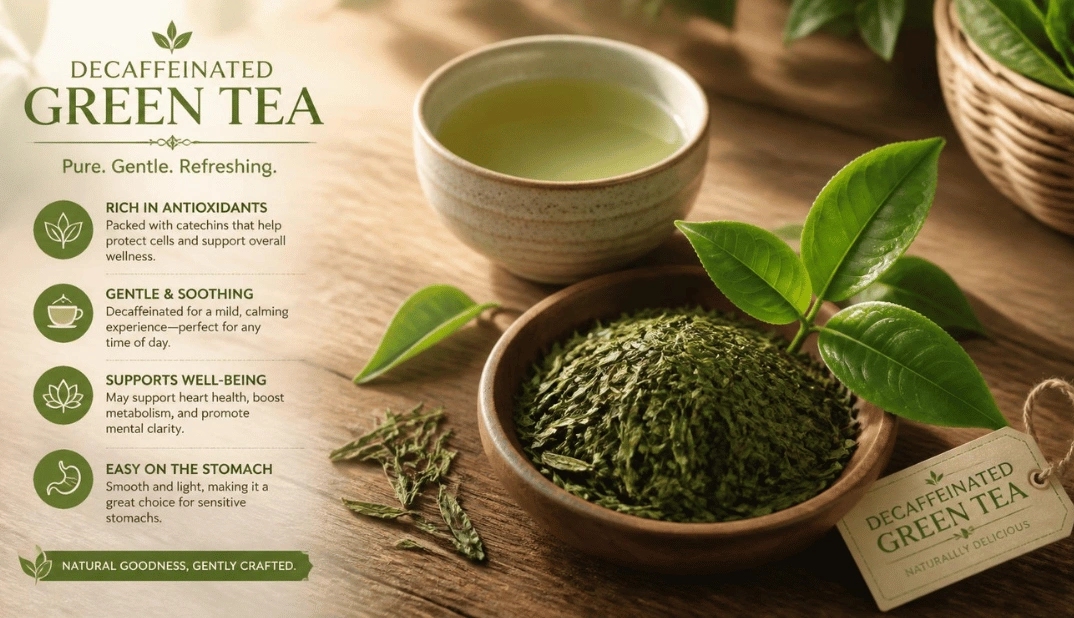
Search this topic, and page one hands you brands. Almost nobody explains the step that decides what ends up in your mug, which is how the caffeine was pulled out of decaffeinated green tea. Two industrial methods dominate the shelf, and they treat the leaf very differently.
The other thing nobody says out loud is that decaffeinated green tea is not caffeine-free. A measurable dose survives every commercial process. That matters if you are caffeine sensitive, pregnant, or pouring a cup at 10 p.m.
Decaf tea is made by stripping caffeine from finished leaf using either supercritical carbon dioxide or ethyl acetate. Carbon dioxide works gently and keeps far more of the catechins. Neither method takes out every trace, so plan on a small residual dose in the cup rather than none at all.
| Method | How it works | Catechins kept | Typical taste | Label wording you will see |
| Supercritical CO₂ | Pressurized carbon dioxide behaves like a liquid and binds caffeine selectively, then evaporates away. | Most of them | Close to the untreated leaf, still grassy | CO2 decaffeinated, carbon dioxide process, naturally decaffeinated |
| Ethyl acetate | A chemical solvent washes the leaf and carries caffeine off along with plenty of other soluble compounds. | Far fewer | Flatter, thinner, sometimes faintly sweet or chemical | Naturally decaffeinated |
Key Takeaways
- Decaf is not caffeine-free. Budget for under 12 mg per cup.
- Carbon dioxide protects catechins. Ethyl acetate does not.
- “Naturally decaffeinated” is marketing language, not a method.
- Hard tap water can cut the catechins in your cup by more than half.
- Brew at 175°F for two minutes, then take the leaf out.
What the Word “Decaf” on a Tea Box Really Means

No US law forces tea to hit a specific caffeine number before a packer can print the word. The working benchmark, borrowed from coffee, is around 97% removal. Strip 97% from a leaf that would have given you 30 mg, and you still swallow close to 1 mg.
Decaffeinated green tea: Watch the phrase “naturally decaffeinated” too. It sounds like warm water and patience. In practice, that wording usually points to carbon dioxide, though some packers stretch it to cover ethyl acetate, because that compound also occurs in ripe fruit. If a box refuses to name its method, email the company. The good ones answer within a day.
Supercritical CO₂ versus Ethyl Acetate
Both processes start with a dry finished leaf and end with a dry finished leaf. What changes is the solvent doing the work, and how fussy that solvent is about grabbing caffeine instead of everything else.
Your Water is Doing More Damage Than The Decaffeination

Here is the part nobody selling tea wants to raise. Catechins are the antioxidants that make the leaf worth drinking, and your tap water decides how many of them reach your mouth. You can buy the gentlest carbon dioxide decaf on the market, then ruin it in ten seconds.
Chemists tested this directly. In a 2021 study published in the journal Molecules, tea brewed in very hard water at 338 ppm of calcium carbonate yielded 67.5 mg of total catechins per cup. The same leaf in very soft water gave 164.6 mg per cup. EGCG came out 3.2 times lower in the hard sample. Alkaline minerals oxidize the catechins before you ever taste them, and the liquor turns dull brown instead of pale gold.
That is a bigger loss than anything the decaffeination plant did to your tea. Chasing a premium tin while brewing it in scale-heavy water is spending money in the wrong place.
If your kettle furries up white inside, you have your answer.
Treating the supply fixes the cause rather than the symptom. Before committing to years of hauling bottled water home, it pays to check how much a water softener costs against what you already spend. Filtering at the sink is the cheaper first move. If you are already installing a kitchen faucet, running a filtered line at the same time adds little to the bill. It takes the mineral edge off every cup you pour.
Is Decaffeinated Green Tea Still Good for You?
Yes, with an asterisk. Caffeine was never the compound doing the antioxidant work anyway. That job belongs to the catechins, above all epigallocatechin gallate, the one usually shortened to EGCG.
Catechins are water-soluble and heat-sensitive, exactly like caffeine. So any process that chases one molecule will drag some of the other out with it. Selectivity is the whole ball game.
Pressurized carbon dioxide is picky, and it leaves most of the catechins sitting on the leaf. Ethyl acetate is not picky at all. The solvent strips catechins alongside the caffeine, which is why a treated bag can taste thin and deliver less EGCG than the same garden’s untouched leaf. If antioxidants are your reason for buying decaf, the method printed on the box is the entire decision.
How Much Caffeine Is Left in One Cup?

Numbers beat adjectives here. Chin and colleagues brewed 20 commercial teas for a 2008 study in the Journal of Analytical Toxicology. The decaffeinated samples held under 12 mg of caffeine per 6 oz or 8 oz serving. Regular white, green, and black teas ran from 14 mg up to 61 mg. So the ceiling is low. It is not zero.
Three habits push residual caffeine toward the top of that range:
- Stepping past three minutes, which keeps pulling whatever is left.
- Doubling the leaf because the cup tastes weak.
- Using dusty bagged tea, where the tiny particles give up their contents fast.
For scale, an 8 fl oz mug of drip coffee usually lands between 80 mg and 100 mg.
How to Brew Decaf so It Does Not Taste Flat
The decaffeinated leaf has already been through a solvent bath and a second drying. It is more fragile than an untreated leaf, so rough brewing punishes it harder.
- Heat water to 175°F rather than a rolling boil. Boiling water scorches delicate leaves and drags bitter tannins forward.
- Use one teaspoon of loose leaf, or one bag, per 8 fl oz.
- Steep for two minutes on the first infusion. Taste it, then give it another 30 seconds if it reads thin.
- Take the bag out. Leaving it in is the most common reason decaf tastes stewed.
- Skip the microwave. Uneven heating drives part of the mug past 200°F while the rest sits lukewarm.
A variable-temperature kettle handles all of this for about $40. Household hot water is a separate question. If yours runs cold partway through a job, comparing the best tankless water heater options will do more for your kitchen than any brewing tip ever could.
Cold brewing is the other route worth trying. Drop two bags in a quart jar of cold filtered water, refrigerate overnight, and strain in the morning. Low-temperature extraction pulls sweetness forward and leaves the bitter compounds behind, which flatters the fragile treated leaf. It also sidesteps the hard water problem, because the oxidation that browns a hot brew barely gets started in the fridge.
Who Should Still Go Carefully?
Decaf is not a free pass for everyone. Caffeine sensitivity varies enormously between people, and four cups at 12 mg each still adds up to 48 mg.
Pregnant readers working to a 200 mg daily ceiling have plenty of room but should count the cups rather than assume they are nothing. Anyone told by a clinician to reach zero caffeine, whether for a heart rhythm problem or a drug interaction, should ask about tea specifically. Concentrated green tea extract supplements are a separate question again, and they belong in that same conversation.
Storing it before it goes stale

Treated leaves age faster than untreated leaves because the process opens up the cell structure and blows off some of the aromatics that made the tea worth drinking. Keep it in an opaque, airtight tin, well away from the stove and the dishwasher steam. Buy small amounts more often. Six months in a dark cupboard is fine, and two years is not.
Conclusion
Decaffeinated green tea is an excellent choice for people who want the health benefits of green tea without the high caffeine content, but it is important to remember that decaf does not mean caffeine-free. Most cups still contain a small amount of caffeine, while the decaffeination method plays a major role in preserving beneficial antioxidants such as EGCG.
Carbon dioxide (CO₂) processing generally retains more of the tea’s natural flavor and nutrients than ethyl acetate processing. To get the best taste and maximum health benefits, brew decaf green tea with filtered water at the correct temperature and avoid over-steeping. By choosing a high-quality decaf tea and preparing it properly, you can enjoy a flavorful, antioxidant-rich drink any time of the day, including the evening.
Frequently Asked Questions
Yes. Decaffeinated green tea keeps a small residual dose, usually under 12 mg per cup. Rooibos and other herbal infusions are the only genuinely caffeine-free options.
Carbon dioxide, clearly. It works selectively, leaves nothing behind worth worrying about, and preserves far more catechins. Ethyl acetate survives because it is cheaper.
Most people can. A cup at 9 p.m. carries roughly the caffeine of a square of dark chocolate. Stop three hours before sleep if you are unusually sensitive.
It does, though how much depends entirely on the method. Carbon dioxide-processed leaf holds most of its EGCG. Solvent-processed leaf holds noticeably less.
Two usual suspects. Water that is too hot or too hard, and a bag left sitting far too long. Fix your temperature this week and your water next, before you go blaming the brand.